
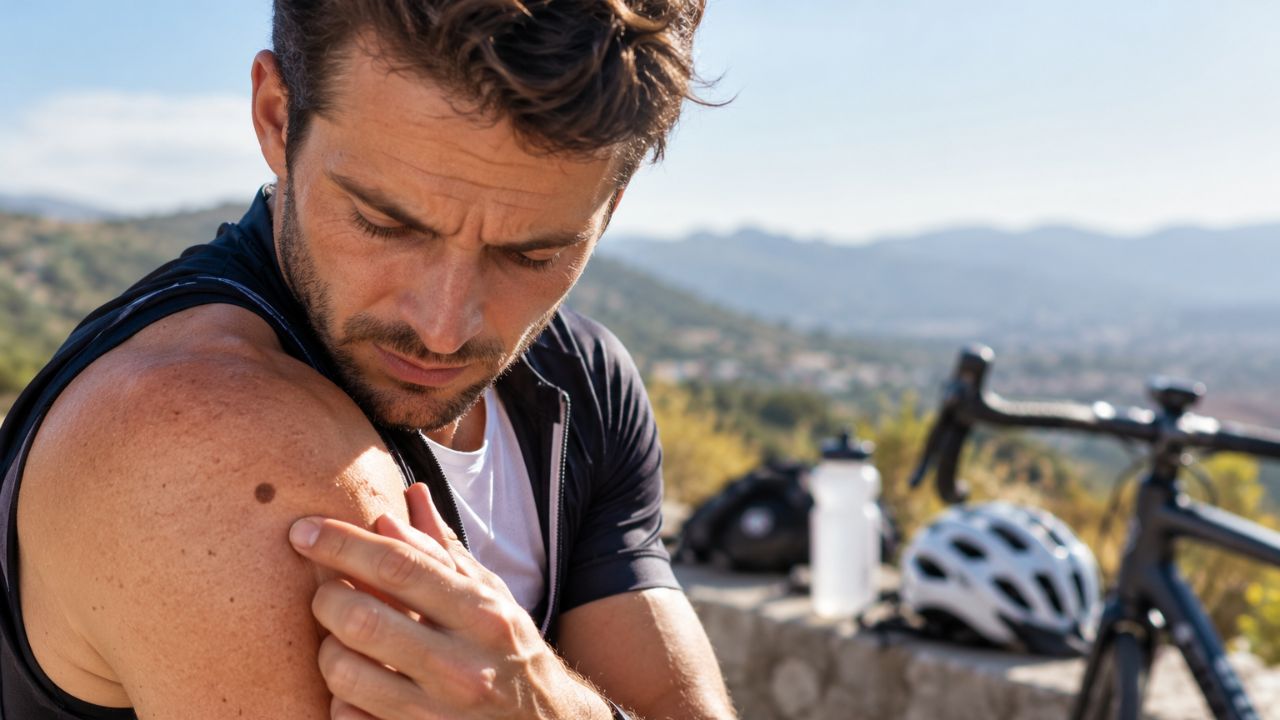
Sun Exposure for Outdoor Athletes: Spotting Skin Cancer Early
Runners, cyclists, climbers, golfers, surfers and sailors share one hazard that does not appear in any training plan. Hours outside, often at midday and often in thin clothing, add up to a large lifetime dose of ultraviolet light. Skin cancer is common and often curable, and the key is to find it early.
Why athletes carry extra risk
Time is the main factor. A person who trains outdoors for ten hours a week accumulates far more exposure than an office worker who sees the sun at weekends. Sweat, wind and water can wear sunscreen away, and reflected light from water, sand or snow adds to the dose.
Habits compound the problem. Races start in bright morning light, long rides cross open country with no shade, and many athletes avoid heavy sunscreen because it stings the eyes or feels greasy. Caps and sunglasses protect part of the face but leave the ears, neck and lips exposed.
The practice of Jonathan Dunne, a consultant plastic surgeon who leads a skin cancer service, includes a blog post on what to look for when it comes to skin cancer. Its listing states that skin cancer is common, often curable and best addressed when identified at an early stage, and that patients routinely ask which changes merit attention.
Sun safety that works for sport
The NHS sets out the basics in its guidance on sunscreen and sun safety. It advises spending time in the shade when the sun is strongest, which in the UK is between 11am and 3pm from March to October, never burning, covering up with suitable clothing and sunglasses, and using sunscreen of at least SPF 30. It adds that the UV index can be checked on a weather app and that protection is worth considering when it is 3 or higher.
The guidance says sunscreen should be applied to areas not protected by clothing, such as the face, ears, feet and backs of hands. Those are exactly the places athletes miss, along with the back of the neck, the tops of the shoulders and the scalp where hair is thin.
Plan training around the sun when you can. Move hard sessions to early morning or evening, choose shaded routes for midday and wear close-woven, long-sleeved kit with a brimmed cap. Reapply sunscreen on long outings, and more often when sweating.
Choose products with sport in mind. Water-resistant formulas, sticks for the face and ears, and lip balm with sun protection are less likely to run into the eyes. Apply sunscreen before you dress, so that no strip of skin is missed, and carry a small tube for long outings.
What to look for on your skin
Changes to skin matter more than any single spot. The NHS lists a new mole, growth or lump among the changes to check for. Melanoma often shows as a mole that changes in size, shape or colour, has an irregular border, is more than one colour or bleeds or crusts.
Basal cell carcinoma often appears as a pearly or waxy bump or a sore that bleeds and does not heal, and squamous cell carcinoma as a scaly, crusted or rough patch that may be tender. Both are most common on the face, ears, scalp, neck, shoulders and backs of the hands, which are the areas athletes expose most.
A sore that has not healed within about four weeks should be seen by a doctor, and so should any lesion that grows or changes. Do not assume that a spot is harmless because it does not hurt. Pain is not a reliable guide.
A routine for checking
Check your skin once a month. Use a mirror, or ask a partner or training partner to look at areas you cannot see, such as the back and scalp. Include the soles of the feet, between the toes, under the nails and the lips, which are easy to forget.
Take photographs of moles and marks in the same light, with a coin or ruler beside them for scale, and keep them in a folder. A comparison across months is far more informative than memory, and it helps a doctor judge whether a change is real.
Athletes who have had many sunburns, have fair skin, have many moles or have a family history of melanoma may be offered regular skin checks. Ask a GP whether yearly examination is appropriate. Tell the GP about sunburn history, tanning bed use, immunosuppressant medicines and any previous skin cancer, since each changes the advice. Honesty helps.
When to see a doctor and what happens next
See a GP promptly about any changing or non-healing lesion. If cancer is suspected, the GP will refer you urgently or routinely depending on the features, and a specialist will examine the lesion, often with a dermatoscope, and may take a biopsy.
Treatment depends on the type and stage. Many skin cancers are removed with a simple operation under local anaesthetic, and early melanoma is usually cured by excision. Facial lesions may need reconstruction by a plastic surgeon, and some need further treatment or monitoring.
Training can resume after healing, with advice about protecting the scar from the sun. Treat the diagnosis as a prompt to improve your habits, not as the end of outdoor sport. Many athletes find that a short conversation with a dermatology nurse about protecting scars and choosing kit is enough to resume training with confidence. Keep appointments for follow-up, since people who have had one skin cancer are more likely to develop another.